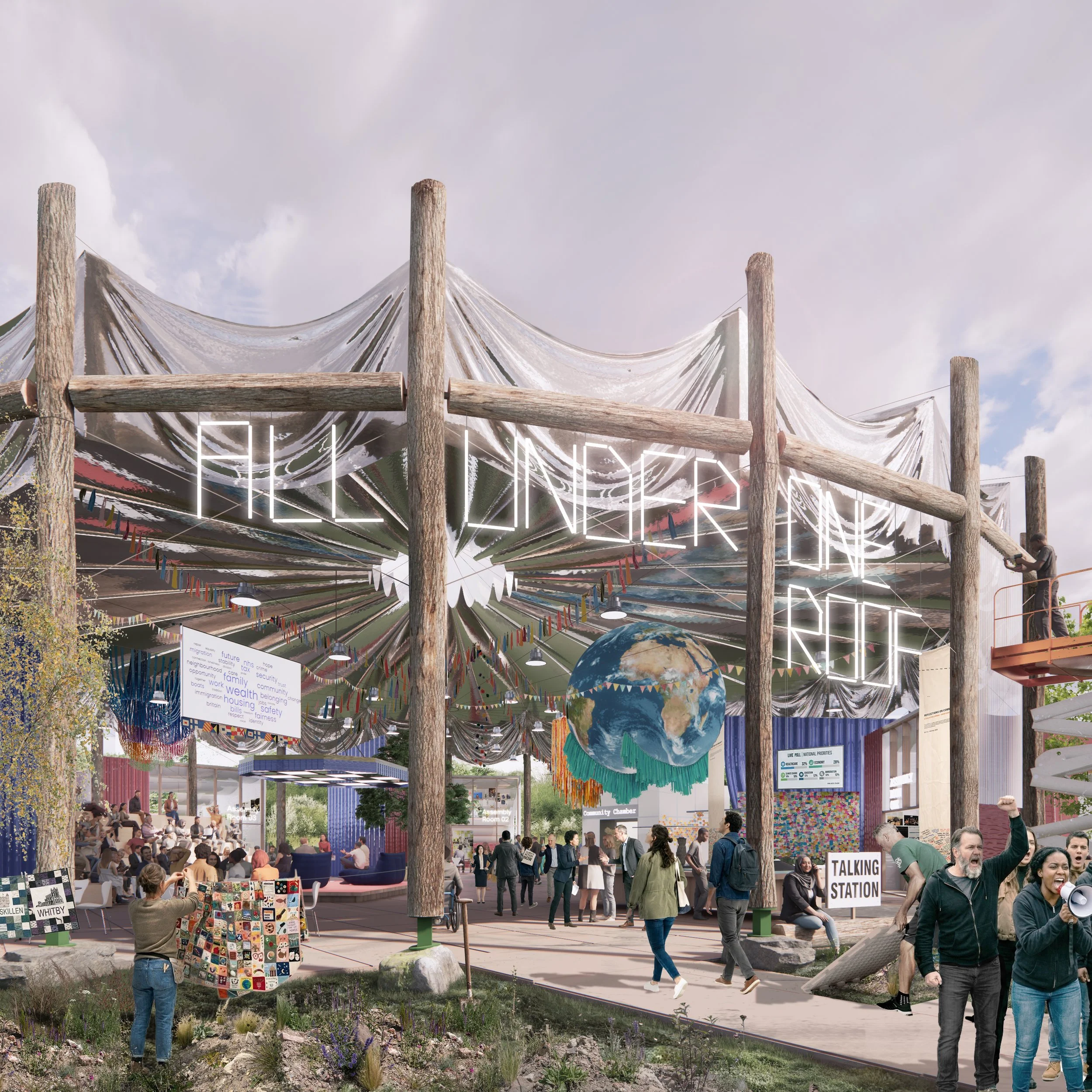
All Under One Roof
Year
2026
Type
Exhibition
Client
Museum of Architecture
Status
Competition
In 1851, the Crystal Palace gathered the products of the world beneath a single monumental roof, projecting Britain as an imperial and globally dominant force. The wealth, resources and technological progress celebrated by the Great Exhibition were broadly inseparable from colonial extraction, global trade networks and unequal systems of labour that allowed Britain to industrialise so rapidly. Standards of comfort, infrastructure and economic security established in Britain during this period and were built upon these global imbalances.
Today, as nations confront ecological collapse, widening inequality, conflict and resource scarcity, the assumptions that sustained this model of progress are increasingly unstable. A new global equilibrium is required: one based not on extraction and dominance, but on coexistence, exchange and shared responsibility.
All Under One Roof imagines a new kind of gathering space: a travelling civic infrastructure for public assembly, debate and participation. Rather than occupying a permanent site in London, the structure moves between towns and cities across the UK, temporarily inhabiting vacant park land and post-industrial spaces. The project responds to growing social fragmentation by creating spaces where people encounter one another physically rather than through digital platforms and algorithmic isolation.
The proposal takes inspiration from Britain’s ancient gathering sites, including stone circles, commons and civic marketplaces. Organised around a circular plan, the structure creates a shared democratic space without hierarchy. At its centre is a public forum for discussion, performance and collective events, surrounded by flexible chambers hosting exhibitions, workshops, debates and community-led programming reflecting the concerns of each place it visits. Stone footings and self-seeded planting are left behind, leaving a mark after the building moves on.
Constructed from raw timber elements and lightweight tensile canopies, the structure is assembled, dismantled and reconfigured to suit the needs of engagement that happen within. British-grown round wood structures support expandable fabric enclosures and polycarbonate facades, that adapt to changing uses, audiences and climates. As the project travels, new components, textiles, messages and contributions are added by local communities, allowing the architecture to physically accumulate the voices and identities of the places it inhabits. The building is never complete but continuously rewritten through participation.
Rather than presenting fixed narratives, the exhibition becomes a framework for ongoing conversation around housing, migration, inequality, climate, identity and belonging. Shared meals, performances, assemblies and informal encounters sit alongside debate, exhibitions and protests, recognising that civic cohesion emerges from sustained public exchange.
Instead of displaying the world beneath British power, this proposal creates a space for Britain to meet itself, and to ask how it might now belong to the world differently.